
Multifamily owners and operators
Balconies, stairs, and walkways are both a liability and a capital item. You need them repaired properly and documented.
Dry Rot & Water Damage
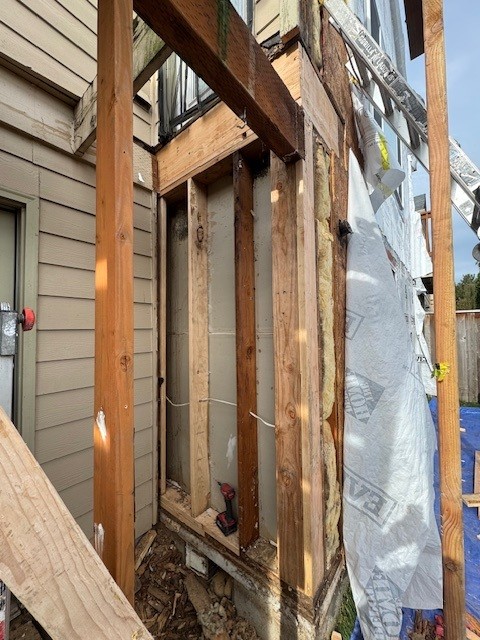
In the Pacific Northwest, dry rot is the quiet destroyer of multifamily exteriors. Leeway opens it up, repairs the structure properly, and corrects the drainage detail that caused it.
Get a Free Scope ReviewSoft trim, a spongy balcony, a stair tread that flexes, paint that will not hold — those are symptoms. The damage behind them has usually been developing for years, and it follows the water: down a wall, along a joist, into a stringer or a rim board.
We open the area until we reach sound material. That sometimes means the scope grows past the original estimate, and we would rather tell you that on site with photos than close the wall over rotten framing so the number stays pretty.
Then we fix the cause. Flashing details, deck coatings and drainage, gutters and downspouts, siding laps, grade and splash — the repair is not finished until the water has somewhere else to go.
Who this is for
Balconies, stairs, and walkways are both a liability and a capital item. You need them repaired properly and documented.
You have a soft spot residents are reporting and need a contractor who can tell you if it is cosmetic or structural today.
You need the extent of envelope and structural damage quantified across a property before you commit a capital number.
Pre-purchase or post-close, you need an honest read on exterior structural condition, not the optimistic one.
Scope of work
Why owners choose Leeway
We remove back to sound material. A repair that stops at the estimate line is a repair you will pay for twice.
Flashing, drainage, and coatings are part of the scope, so the same detail does not rot out again in three winters.
Balconies, stairs, and railings are where structural failure becomes an injury. This work gets prioritized accordingly.
Conditions, demolition extent, and repairs are documented — useful for insurance, warranty, and capital records.
How it works
We assess the affected areas, probe for soft material, and estimate the likely extent before demolition begins.
The area is opened to sound material. You get photos and an updated scope if the damage runs further than expected.
Framing, sheathing, and structural components are replaced to code, with engineering coordinated where required.
Flashing, siding, coatings, railings, and paint are restored to match, and the drainage detail is corrected.
FAQ
We probe and open the affected area until we reach sound material. Guessing at the boundary is how rot comes back, so the demolition extent is determined on site, not from a photo.
It depends on scale. A single fascia section is maintenance. Multiple balconies, stair towers, or a building's worth of siding and framing is a capital project, and we scope it that way.
In most cases yes. Balcony, walkway, and stair work requires temporary access changes, which we plan with management and communicate to residents in advance.
Both. Rot is a water problem. Flashing, drainage, deck coatings, gutters, and grade all get corrected, otherwise the repair is temporary.
Yes — joists, beams, stair stringers, posts, headers, and sheathing. Where a scope requires engineering, we coordinate it and build to the stamped detail.
Anything structural or walkable — balconies, stairs, railings, walkways — should be treated as urgent. Cosmetic trim rot can usually be grouped into a planned exterior program.
Tell us about the asset and the scope. We'll walk the site, define the work, and come back with a budget you can underwrite.